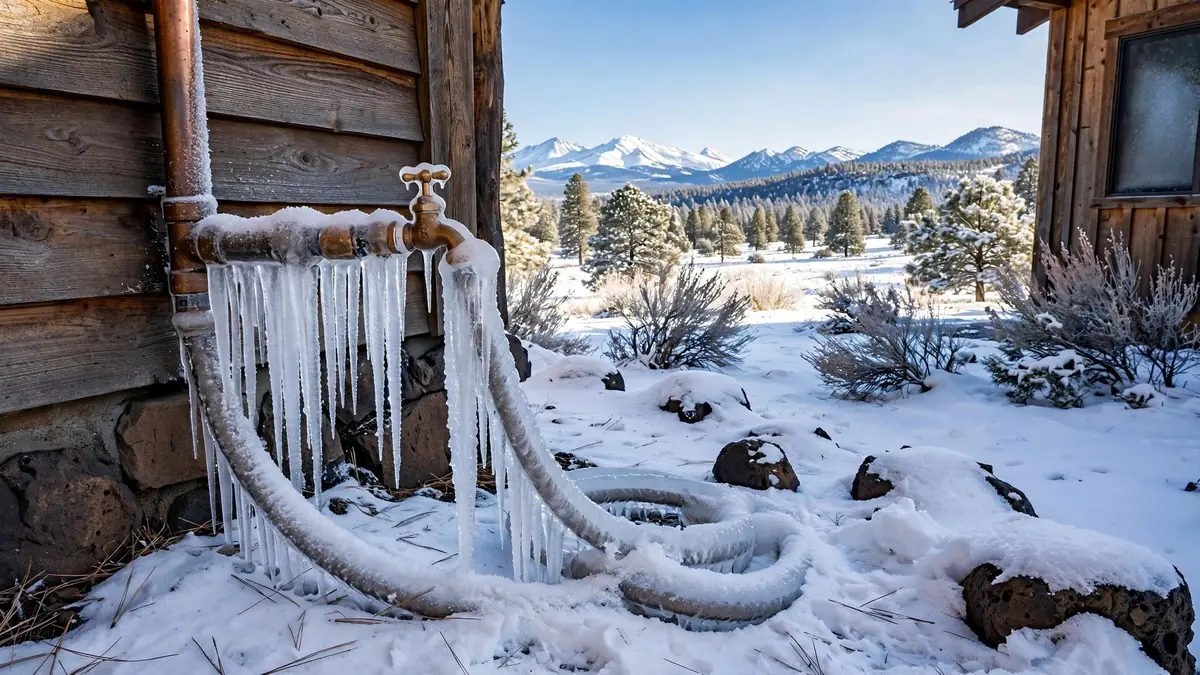
To thaw a frozen pipe safely, shut off the main water valve, open the nearest faucet, and warm the pipe slowly with a hair dryer on low, working from the faucet toward the freeze. Never use an open flame, and call a plumber if the pipe is bulging or hidden in a wall.
Do these four things first
A frozen pipe is usually a slow problem with a fast ending, so the first ten minutes decide how it goes. Start with the main water valve. If the pipe has already split, you want the water off before the ice melts, because the leak only shows once the pipe thaws.
Then open the faucet nearest the frozen section, leaving it open so melting ice and steam can escape. Warm the pipe slowly with a hair dryer on low, working from the faucet back toward the freeze. Never use a torch, a heat gun on high or any open flame. The City of Bend's own guidance says never to use an open flame to thaw pipes.
If the pipe is bulging, cracked or behind a wall you cannot reach, stop and call a plumber.
How Bend pipes end up frozen
Bend does not get the brutal cold of the northern plains, but it gets repeated hard freezes, and houses here are not all built the same. Bend Fire and Rescue has put out frozen-pipe advisories ahead of recent cold snaps, including forecasts of single-digit nights, and the City of Bend publishes its own pipe-freeze tips each winter.
The city's guidance singles out one cause above the rest: open foundation vents. Cold air blowing through a crawlspace chills every supply line in it, and the city says this is probably the greatest cause of frozen or split pipes. Local plumbers add another: homes plumbed during the building boom sometimes left lines under insulated floors exposed to the crawlspace air.
The result is that the pipes at risk are rarely the ones in the heated living space. They are the ones in the crawlspace, in the garage, on exterior walls and in the outbuildings.
Where to look, in order
Think of the freeze as a map. If one faucet is slow and the rest are fine, the problem is in that branch. If the whole house is dry, the freeze is near the main.
| Location | Why it freezes | What to try first |
|---|---|---|
| Crawlspace supply lines | Open vents or gaps let cold air reach bare pipe | Close vents, add heat, wrap pipe |
| Kitchen and bath sinks on exterior walls | Pipe sits against cold sheathing | Open cabinet doors, run a slow drip |
| Garage or laundry room lines | Unheated space and a drafty door | Warm the room, keep the door shut |
| Hose bibs and irrigation | Water left in pipes outside the heated space | Disconnect hoses, drain the line |
| Well house or pressure tank | A small enclosure loses heat fast | Check the heater and thermostat |
What to do while you thaw
A safe sequence for a frozen line
- Turn off the main water valve, in case the pipe is already cracked where you cannot see.
- Open the closest faucet fully, hot and cold if it has both.
- Apply gentle heat with a hair dryer on low, a heating pad or warm towels, working toward the freeze.
- Keep heat sources away from wet floors and flammable materials, and never leave one unattended.
- When water returns, close the valve at once and check the pipe for drips before leaving it on.
- If you cannot find the frozen spot, or you see a bulge, a crack or a stain, call a plumber.
Why a thawed pipe can still leak later
Ice expands as it forms, and it can crack a pipe or a fitting without any visible damage. The pipe holds while it is frozen, then leaks when the ice melts. A homeowner who thaws a line, sees water flowing and goes to work can come back to a wet ceiling.
After any thaw, look at the pipe closely for hairline splits at joints and bends, and check the ceiling and walls beneath it over the next day. A small drip is much cheaper to fix than a soaked floor. If you find one, the work is covered under burst pipe repair, and a plumber can confirm that the rest of the line is sound.
If the same pipe freezes every cold snap, thawing it is only a temporary answer. The line is in the wrong place or the space around it is too cold, and a plumber can reroute, insulate or add heat to fix the cause.
A rule worth remembering
Every hour a frozen pipe stays frozen, the water behind it is under pressure with nowhere to go. Thaw it on your terms, with the main closed, rather than waiting for it to give way.
What a plumber adds that a hair dryer cannot
A plumber has tools a homeowner does not. A thermal camera can show where a freeze sits behind a wall, a controlled heat source can thaw a pipe without scorching the finish, and a pressure test after the thaw shows whether the pipe survived. For a line inside a wall or under a floor, that combination often avoids opening the drywall.
A plumber can also tell you why the freeze happened. A missing section of insulation, a crawlspace vent that was left open or a supply line that runs through an exterior wall are all fixable once someone has looked.
How to keep it from happening again
Prevention is mostly about air and insulation. Model plumbing codes such as the International Plumbing Code (IPC) say pipes in places subject to freezing must be protected by insulation, heat or both, which is why insulation and sealed vents matter.
Close crawlspace vents in winter, seal gaps where pipes pass through walls and add foam sleeves to lines in unheated spaces. On the coldest nights, open the cabinet doors under sinks on exterior walls and let a faucet drip slowly. Moving water is harder to freeze.
Keep the thermostat at a safe minimum if you travel, and do not turn the heat off in a house with plumbing inside it. For a second home or a rental that will sit empty, a full drain-down is safer than a low thermostat setting. The seasonal rules differ for second homes, and the frozen pipe repair page explains what a plumber does when a freeze has already happened.
Higher ground freezes harder. A house near La Pine sees longer and colder stretches than one in town, so owners there should start precautions earlier in the fall.