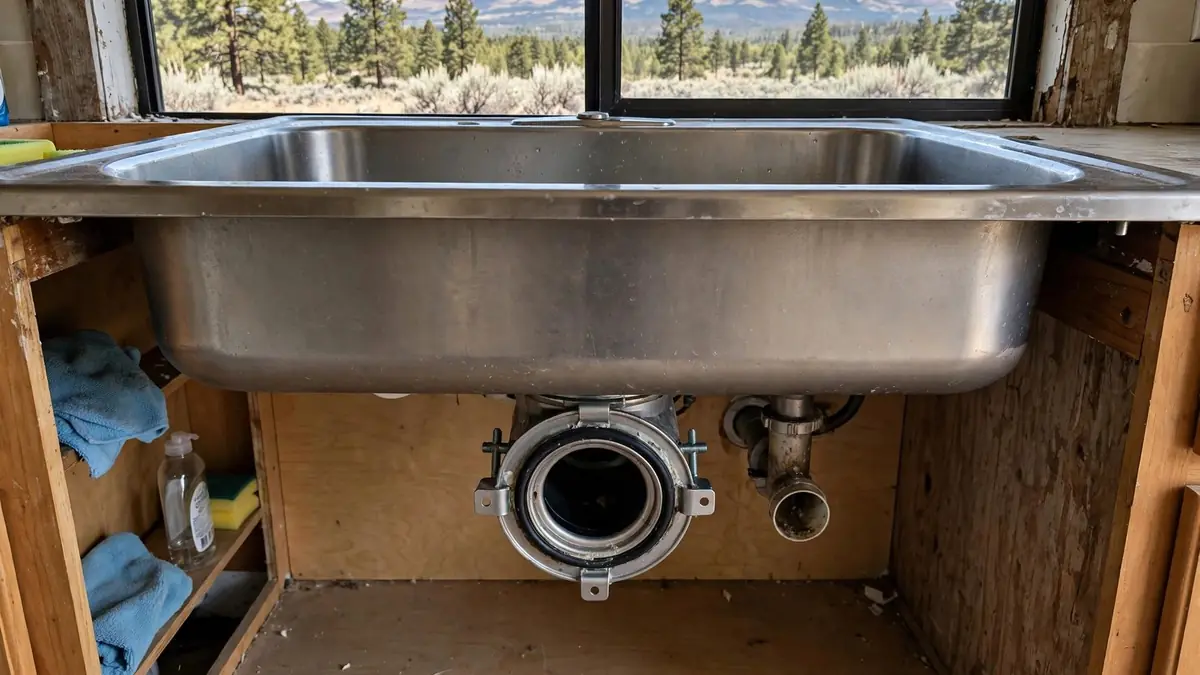
If a garbage disposal hums but will not spin, it is jammed. Turn off and unplug it, free it with the hex wrench in the bottom socket, remove any object with tongs and press the reset button. Water seeping out of the base of the unit means the casing has failed and a new disposal is needed.
Safe first steps for a jam
Do these in order
- Switch off the wall control, then unplug the disposal or flip its breaker. Keep your hands out of the chamber entirely.
- Turn your attention to the underside of the unit, where a small hex-shaped socket sits at the center.
- Insert the hex wrench that came with the disposal and work it back and forth until it turns freely.
- Remove any visible object with tongs or pliers, not fingers.
- Once the motor has cooled, push the small red reset button on the underside.
- Switch power back on, run the cold tap and try a few ice cubes.
Humming means jammed, silence means power
A disposal that hums but does not spin is jammed, usually by a bottle cap, a fruit pit or a hard bone fragment. The hex wrench frees it. A disposal that does nothing at all and does not hum has lost power, usually from a tripped breaker or the reset button.
A disposal that runs but drains slowly may be fine itself, with the clog downstream in the trap or branch line. Do not use chemical drain cleaners in a sink with a disposal, because they sit in the unit and corrode its parts. If the sink backs up after the disposal runs, the drain line needs attention.
Where leaks come from
Water at the very bottom of the casing is the one leak location that ends the repair conversation. Anywhere else, a repair usually works.
| Spot where water appears | Usual culprit | Who can fix it |
|---|---|---|
| Around the sink opening above | Putty that has dried out or a slack mounting ring | Handy homeowner, with the unit unmounted |
| Beside the dishwasher connection | A worn clamp or a cracked rubber hose | Handy homeowner or plumber |
| At the pipe leaving the unit | A tired gasket or loose flange bolts | Plumber, or a confident DIYer |
| Underneath the unit itself | A failed internal seal or a cracked casing | Replacement, usually by a plumber |
| Somewhere in the cabinet, hard to tell | The trap or the branch drain, not the disposal | Plumber, after a dry-paper test |
Repair or replace
A disposal that jams once in a while is fine. One that jams repeatedly, hums with no power or leaks from the housing is worth replacing. Expect roughly a decade of service, give or take a few years, and treat a leaking unit older than that as a candidate for replacement.
When buying, a half or three-quarter horsepower model suits most homes. Look at the grinding stages, the sound insulation and the warranty. The garbage disposal repair and installation page describes the installation details, including the dishwasher knockout plug, a small plastic disc inside the dishwasher inlet that must be removed or the dishwasher cannot drain.
If your kitchen has other problems, such as a dripping faucet or weak stops, a single visit can often cover them. See faucet and sink repair for that side.
What not to grind
The Uniform Plumbing Code (UPC) expects a disposal to drain through an accessible, properly vented trap, which is why a sagging or crowded trap causes repeat jams. Keep the cold tap running while you grind and for a short while afterward. Cold water keeps fats solid so the blades can chop them, and helps carry the waste through the trap.
- Grease, oil and fat that harden in the trap.
- Coffee grounds, eggshells and starchy foods like pasta and rice in volume.
- Fibrous vegetables such as celery, corn husks and artichokes.
- Bones, fruit pits and hard shells.
- Non-food items of any kind.
Choosing a replacement
A half horsepower disposal handles most households, three-quarter horsepower grinds more finely and runs more quietly, and a one horsepower unit suits heavy use. Look at the grinding stages, the sound insulation and the warranty, since those differ more between models than the horsepower does.
Check the mounting. Many brands use a quick-mount system that fits existing sink flanges, which simplifies replacement. A mismatched mount means a new flange and a plumber's putty seal. Measure the cabinet clearance as well, since some models are taller than the one they replace.
If the kitchen has a dishwasher, make sure the new unit has an inlet for it, and plan to remove the knockout plug. If the kitchen has an air gap, the drain hose connects there.
What installation day looks like
Installation takes an hour or two when the existing connections are in good condition. A corroded trap or a failed shutoff adds time and parts.
Odors and slow draining without chemicals
A disposal that smells is usually holding food residue under the splash guard and on the blades. Remove the rubber splash guard if it lifts out and scrub it with a brush and dish soap. Run cold water, then grind a handful of ice cubes and a few citrus peels to scrape the chamber and freshen it.
Baking soda and white vinegar fizz in the drain and loosen residue, but they will not clear a real clog. Skip bleach and drain cleaners, which can damage seals and are hazardous if they splash. If the odor persists after cleaning, the smell may come from the trap or the branch line, not the disposal.
A disposal that drains slowly even when clean points to the trap or the line beyond it. Pull the trap under the sink and check it for packed food. If the trap is clear and water still moves slowly, the clog is further down the line, and a plumber with a cable can clear it.
Special cases: septic, rentals and older kitchens
Homes on septic systems should use the disposal sparingly. Every scrap the blades grind ends up as extra sludge in the tank, so pumping comes around sooner. Some septic owners skip the disposal altogether. Ask your septic professional before installing one.
Rentals and vacation homes see odd items go down the sink. A strainer in the drain and a note about what not to put in prevent most calls. In places like Sisters with busy rental seasons, owners often add a check of the kitchen sink to the turnover routine.
If water backs up out of the disposal into the other side of a double sink, the main kitchen line may be clogged. That is a job for clogged drain service, not the disposal.