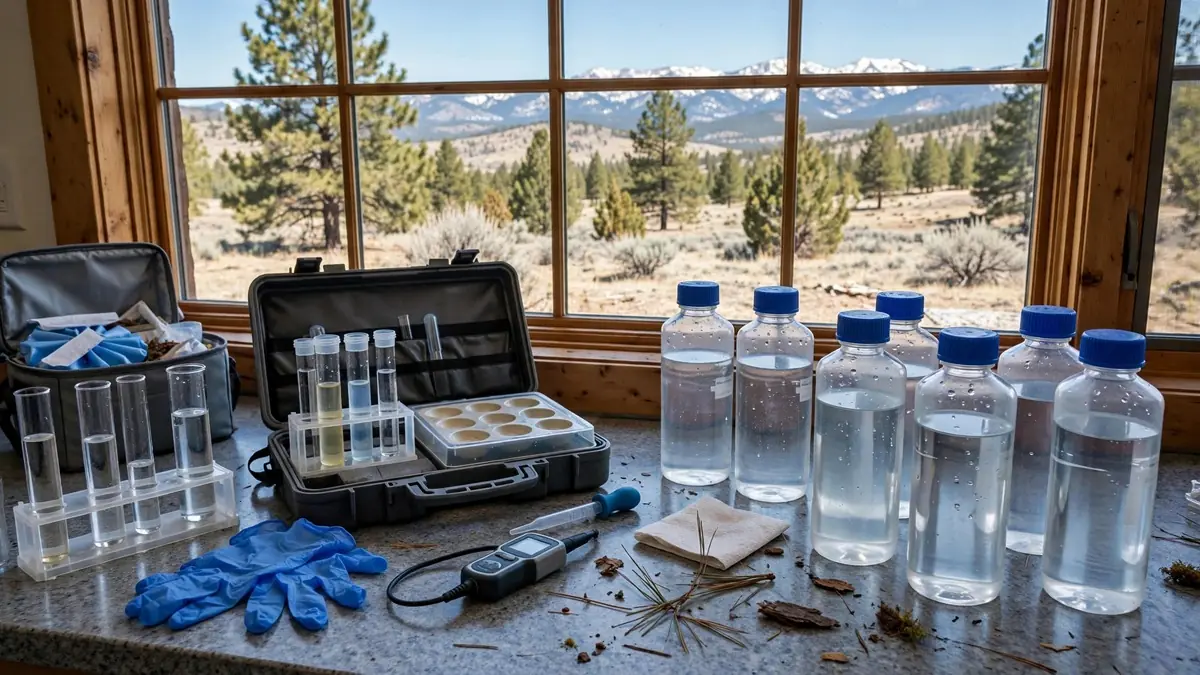
Nitrate in south Deschutes County wells comes mostly from septic systems over a shallow aquifer, according to Oregon DEQ, the USGS and the county. A plumber can repair the pump and install treatment equipment, but only a lab test can tell you whether your water has nitrate in it.
Why this area has a nitrate story
Around La Pine and Sunriver, most homes get their drinking water from private wells, and the aquifer under them is shallow. The U.S. Geological Survey reports that at least half of the wells near La Pine draw from the upper 50 feet of the aquifer. Oregon's Department of Environmental Quality, the USGS and Deschutes County have all concluded that the area is vulnerable to nitrate from septic systems.
Nitrate is a nitrogen compound found in human waste. When conventional septic systems sit over a shallow, porous aquifer, nitrate reaches the groundwater. The USGS reports that studies in 1979 and 1982 documented nitrate contamination in La Pine core-area wells, and Oregon DEQ then required community sewage treatment for the core area. The county has spent decades on programs to protect the rest.
What the recent testing found
In 2023 and 2024 DEQ sampled about a hundred private wells between Sunriver and La Pine. County materials report that wells north of Burgess Road and in La Pine showed increases in nitrate. Separately, state records of private well tests done during real estate sales in the upper Deschutes area show a few hundred results at or above three milligrams per liter.
Those numbers do not mean every well is contaminated, and they do not say yours is. Nitrate varies by well depth, location and the age of nearby septic systems. They do mean that anyone buying or owning a well in south county should test it.
Who does what
The 10 milligrams per liter figure is the federal limit for public water systems. Private wells are not required to meet it, but it is the benchmark most labs and agencies use.
| Task | Who handles it | Notes |
|---|---|---|
| Testing for nitrate | A certified lab | Ask for nitrate and nitrite on a well sample |
| Interpreting the result | Lab report and your health provider | Federal drinking water limit for public systems is 10 mg/L |
| Choosing treatment | You, with a water treatment professional | Match equipment to the lab result |
| Installing treatment | A licensed plumber | Bypass, drain and code-compliant connections |
| Septic tank service | A DEQ-licensed septic professional | Separate trade from plumbing |
What plumbing can and cannot fix
A plumber cannot judge nitrate by looking at, tasting or smelling water. Nitrate has no taste or color. The only way to know is a lab test, and no plumbing repair changes the result.
What a plumber can do is install equipment that treatment professionals recommend after a test. Reverse osmosis and ion exchange are the types commonly used for nitrate, and a product's performance claim should be backed by a listing under an NSF/ANSI standard such as 58 for reverse osmosis. A plain sediment or carbon filter does not remove nitrate.
Point-of-use systems under a sink treat drinking and cooking water only and are the usual choice. Whole-house systems for nitrate are more costly and less common. The filter system installation page explains the options and why testing comes first.
Steps for a south county well owner
What to do if you rely on a south county well
- Test the well for nitrate and nitrite with a certified lab, and repeat it every year or two.
- Keep the report with your house records, and compare results over time.
- If the result is high, talk to the county or your health provider about what it means for your household.
- Choose treatment based on the lab result, and ask for the product's NSF/ANSI listing.
- Have the pump, tank and well cap checked so the system itself is not letting contaminants in.
- If you are buying a home, ask for the latest well test and the age of the septic system.
If you are buying a home on a well in south county
A real estate sale is the best moment to test a well, because the result can still change the deal. State records show that hundreds of private well tests have been done during Upper Deschutes real estate transactions, and some of them came back at or above three milligrams per liter of nitrate.
Ask for the most recent water test, the date of the sample and the lab that ran it. Ask how old the septic system is, where it sits compared to the well and whether the tank has been pumped on schedule. A well downhill from an old septic system on a small lot is a different risk than one on a large parcel with a newer system.
Also ask about the pump and pressure tank. Both are expensive and age out. A buyer who knows their age can budget for replacement.
Reading a result
A lab report lists nitrate as nitrate-nitrogen, in milligrams per liter. The federal limit of 10 milligrams per liter applies to public water systems, and it is the number most people compare against. A reading of three milligrams per liter is often treated as a sign of human influence on the groundwater even though it is well below the limit.
A single test is a snapshot. Nitrate can change with the season, with pumping and with nearby septic activity. Repeating the test every year or two shows the trend, which matters more than any one number.
Wells, pumps and the rest of the system
Nitrate is a water quality issue, but a well is also a mechanical system. A failing pump can pull air, a cracked cap can let in surface water, and a waterlogged tank can wear out the pump. Maintaining the mechanical side is plumbing, and it is covered on the pump and pressure tank repair page.
Local conditions matter too. The La Pine page describes the sewered core, the outlying septic subdivisions and the winter freezes that hit well houses, and the Sunriver page explains why Sunriver itself, with its own sewer system, differs from the properties around it.
This article is general information and is not medical advice. If anyone in your household has a health concern related to drinking water, speak to a doctor and to the county.