Water Filtration Installation in Bend, OR
Whole-home and under-sink filtration, matched to a water test instead of a sales pitch.
Your water tastes off, or a test came back with something
People look into water filtration for a few honest reasons. The water smells of chlorine or sulfur, a lab report listed a contaminant, or a salesperson at the door named a scary number. Each one calls for a different response, and the order matters: test first, choose equipment second.
Water filtration installation in Bend is the plumbing side of that choice. A plumber sets the unit on the line, adds bypass valves and drains, and meets code. A plumber does not diagnose water safety by looking, and no filter should be chosen without knowing what it is meant to remove.
If your water comes from the City of Bend or Avion Water Company, ask the provider for its latest water quality report. Avion says its water is drawn from deep wells and is delivered untreated, and the city reports regular testing. A private well has no such report and should be tested by a lab.
Match the test to the concern
| Concern | What to ask a lab to test | Usual equipment family |
|---|---|---|
| Taste or chlorine smell | Chlorine residual, general mineral panel | Carbon filter |
| Rotten-egg smell | Hydrogen sulfide, pH, iron | Specialty media filter or aeration |
| Rust stains, orange water | Iron, manganese, pH | Iron filter, sometimes with a softener |
| Nitrate on a private well | Nitrate and nitrite | Reverse osmosis or ion exchange at the point of use |
| Sediment or cloudy water | Turbidity, particle size | Sediment prefilter |
| Hardness and scale | Total hardness | Softener, covered on its own page |
The equipment column is a family, not a prescription. The lab result and a product's certified claims decide the actual choice.
Standards that tell you what a filter can claim
NSF/ANSI listings
NSF/ANSI Standard 42 covers filters that improve taste and odor, including chlorine. Standard 53 covers filters that claim to reduce health-related contaminants. Standard 58 covers reverse osmosis systems for drinking water.
A box that says a filter removes a contaminant should also state the standard and show it is listed by an accredited certifier. If the claim has no listing behind it, treat it as marketing.
Nitrate and wells
The Oregon Department of Environmental Quality and Deschutes County note that the shallow aquifer around La Pine and Sunriver is vulnerable to nitrate from septic systems, and that private wells are the main water source for most properties there. Nitrate is not removed by a simple carbon filter.
Reverse osmosis and ion exchange are the types commonly used for nitrate, and the lab result and the certified claims on a specific product decide. This site cannot tell you whether your water is safe, and a plumber should not either.
Where the equipment goes
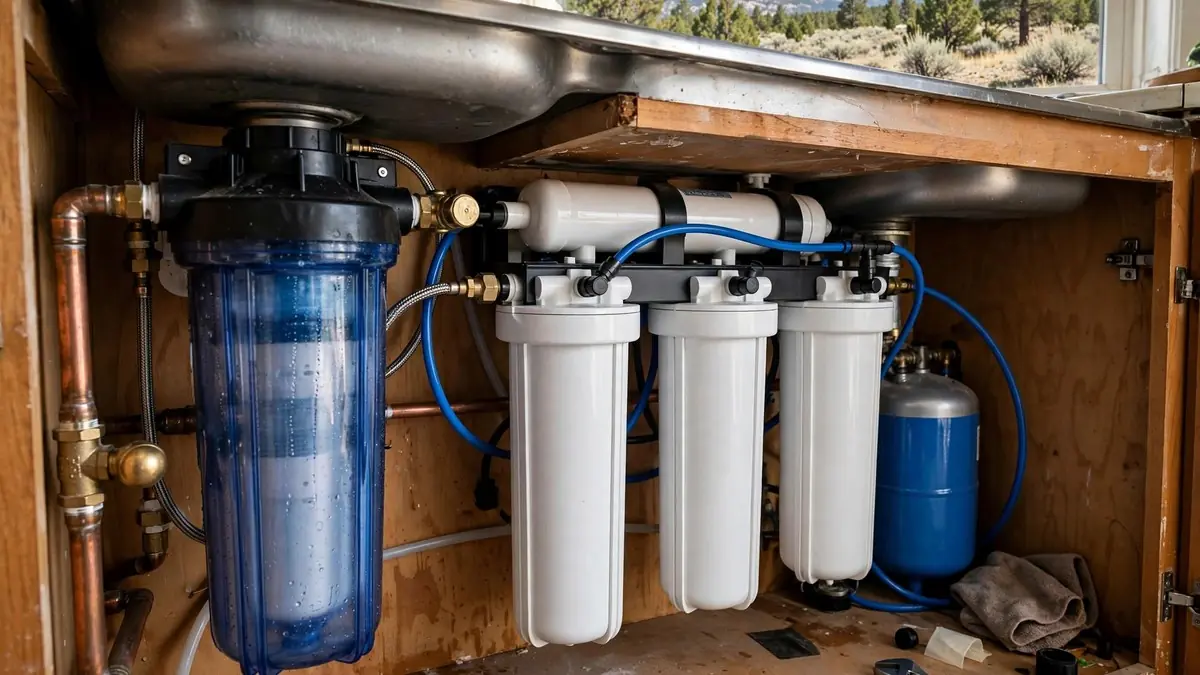
A whole-home system treats all water entering the house and suits sediment, chlorine or iron. A point-of-use system sits under a sink and treats only drinking and cooking water, which is typical for reverse osmosis. Using a point-of-use unit for a drinking-water concern is cheaper and wastes less water than treating every tap.
Every installation needs a bypass, so water keeps flowing during filter changes, and a drain connection for any system that backwashes or rejects water. Under the Oregon Plumbing Specialty Code, built on the Uniform Plumbing Code (UPC), drains need an air gap or approved connection to protect the water supply.
Homes with a water heater, softener and filter in the same utility space benefit from planning the layout once. The order in which equipment sits on the line affects performance and service access.
From test result to working system
Review the test
The lab report sets what must be removed.
Choose and size
Equipment is matched to flow rate and the household.
Install
Valves, bypass, drain and mounting are done to code.
Start up and schedule
Flow is tested and filter changes are scheduled.
Filters only work if they are changed
What to do each year to keep it working
- Write the install date and filter change interval on the unit.
- Replace cartridges on schedule, even if the water still looks fine.
- Retest the water yearly, or as the lab advises, to confirm the system still works.
- Keep receipts and certification sheets for the equipment.
- Sanitize and service according to the manufacturer's instructions.
What changes the price of a filtration system
Treatment equipment is rarely covered by insurance, and most of the cost is the equipment plus yearly filters. Compare quotes on the certified claims, not the brand name.
Where filtration installs are done
Installations are scheduled in Bend and out to private-well homes around the Sunriver area and La Pine. If scale is the issue, water softener installation covers that separate need, and the plumbing around a well is in well pump repair.
Bend's city water measures low in hardness, so most filtration questions here are about taste and sediment rather than scale. Rural parcels outside the city may rely on a private well, and a lab test of that water should drive equipment choice.
Water filtration questions in Bend
Not necessarily. Many homes on city or Avion water use none. A filter makes sense for a specific concern, such as taste, sediment or a lab result on a private well.
No. Testing is done by a lab. A plumber installs equipment based on your result.
Common carbon filters do not. Reverse osmosis and ion exchange are the usual types, and a lab result and certified claims decide what fits.
It means an accredited certifier tested a product against a published standard for specific claims. The standard number tells you which claim.
It depends on the type and the water. Many cartridges last several months to a year, and the manufacturer's schedule applies.
Yes. The plumber ties it into the line after the pressure tank, with a bypass and a drain if required.
Ready to plan a filtration system?
Call to schedule an install once you have a test result.
Call (503) 974-3329