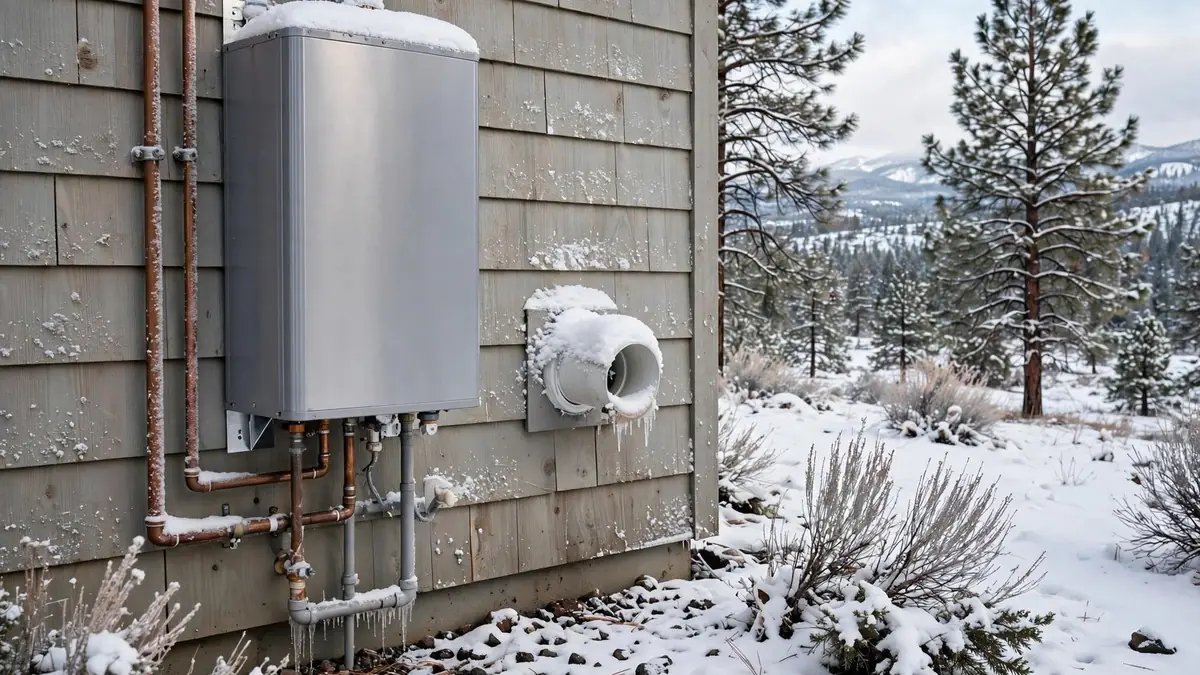
A gas tankless water heater in Bend needs to be set for altitude, matched to a gas line that can feed it and sized for winter flow, not summer. Manufacturers publish high-altitude instructions, and some models call for adjustments above about 2,000 feet.
Does altitude matter for a gas tankless heater?
Yes, and it is one of the few Bend-specific details of a tankless install. Gas appliances burn with oxygen from the air, and the air gets thinner as elevation rises. Manufacturers publish high-altitude instructions because a burner set for sea level can run poorly higher up.
Bend is well above the 2,000-foot mark that many manufacturers use as a threshold, and Sunriver and La Pine sit above 4,000 feet. Rinnai, one major tankless brand, publishes technical bulletins for high-altitude installs. Depending on the model, they call for manifold pressure adjustments above 2,000 feet and vent-length limits above 5,000 feet.
That does not mean tankless is a poor choice here. It means the installer must follow the model's altitude instructions and set the unit correctly at install.
What the altitude bulletins cover
Always read the instructions for your specific model. This table is general, and different brands handle altitude differently.
| Item | What may change | Who handles it |
|---|---|---|
| Gas manifold pressure | May need adjustment above about 2,000 feet for some models | Installer at commissioning |
| Vent length | Shorter maximum runs at higher elevations for some models | Installer when planning the vent |
| Dip-switch settings | Altitude and long-vent settings | Installer from the manual |
| Rated output | May be derated at elevation | Check the spec sheet |
| Combustion test | Verifies safe, clean burning | Installer with a combustion analyzer |
Gas supply and pipe size
A tankless heater can demand a large burst of gas, often more than a tank does. A gas line that served a tank and a furnace may be too small for a tankless unit, which shows up as ignition faults, low output or a heater that quits when the furnace runs. Sizing the line is part of the job.
The installer adds up the BTU load of every appliance on the line, measures the run and checks that pressure holds at full demand. If the line is too small, it must be upgraded, and that cost belongs in the quote. The gas line installation and repair page explains how lines are sized and permitted.
Winter flow is lower than the label says
Tankless heaters list a maximum flow at a stated temperature rise. In Bend, incoming water in January is much colder than in July, so the temperature rise the heater must make is larger and the flow it can deliver falls. A unit that handles two showers in summer may struggle with them in winter.
Ask the installer for the winter flow rate at your target temperature, not the maximum on the box. Count the fixtures that run at once on a busy morning and size for that. A larger unit, or two units, costs more but avoids cold-water complaints.
Electric tankless units face the same issue and add a large electrical load. A panel with little spare capacity may not support one.
Questions to put in writing
Before you sign a tankless quote
- Does the quote state the altitude setting for my elevation?
- What gas line size is needed, and is an upgrade included?
- What is the winter flow rate at my target temperature?
- What vent material and route are planned, and does it meet the model's limits?
- Is a condensate drain included for condensing models?
- Are isolation valves included so the unit can be flushed?
- Who pulls the permit, and what inspection follows?
Tankless or tank in Central Oregon?
Neither is better for everyone. A tank is simpler, a tankless unit saves space and offers continuous hot water, and the right choice depends on how your household uses hot water.
| Factor | Tankless | Tank |
|---|---|---|
| Hot water supply | Continuous, limited by flow rate | Limited by tank size, then recovery |
| Winter performance | Flow falls as incoming water cools | Tank holds heat, but recovery slows |
| Install complexity | Gas line, vent and altitude setup | Simpler venting and gas |
| Maintenance | Yearly flush and filter cleaning | Periodic flush and anode check |
| First cost | Higher | Lower |
| Space | Wall-mounted, small | Floor space needed |
Venting and condensate details
Condensing tankless units are more efficient and produce acidic condensate that must drain to a proper location. They use plastic vent pipe that runs at a slight slope, and the manufacturer limits the length and number of elbows. At high elevation, some models reduce the allowed vent length, so a long run that works at sea level may not work here.
Non-condensing units vent in metal and run hotter. The choice affects where the vent can terminate and how far it can run. Locate the unit with the vent route in mind and confirm that clearances to windows, doors and gas meters meet code.
In cold weather, a vent termination can freeze or collect snow. A plumber should choose a termination location that stays clear, and a homeowner should check it after storms.
Common installation problems
- A gas line that is too small for the unit's maximum demand.
- A vent that runs longer than the model allows, or has too many elbows.
- Altitude settings left at the factory default.
- No isolation valves, which makes flushing hard.
- A condensate line that is not drained properly or can freeze.
- A unit sized for summer flow, not winter.
Maintenance and what comes after
A tankless heater needs a yearly flush, and city water here is soft, so scale builds slowly. Homes on private wells can build it faster. A flush with descaler, a clean inlet filter and a vent check keep the unit running, and the tankless water heater service page covers what a visit includes.
If you are weighing tankless against a tank or a heat pump, the tank replacement page compares them. Because altitude and cold both punish marginal sizing, the higher communities such as La Pine call for extra care in winter.
Installers follow the manufacturer's instructions and the Oregon Plumbing Specialty Code, which builds on the Uniform Plumbing Code (UPC), for venting and gas connections. Installers should also remember carbon monoxide. Any gas appliance needs working alarms nearby, and a vent that is clear.