Water Softener Installation & Repair in Bend, OR
Softeners installed and repaired where a hardness test shows the need, and honest advice where it does not.
Check these before buying a water softener
A short honest checklist
- Find your water's hardness in grains per gallon, from the provider's report or a test.
- Look for real signs: white scale on fixtures, spotty dishes, a crust on the kettle, short water heater life.
- Compare your reading with the table below before spending anything.
- If you are on a private well, test the well itself. It can differ greatly from the city.
- Ask whether a softener would add salt or potassium to your water and whether that matters for your household.
Hardness categories in plain numbers
| Hardness (grains per gallon) | Category | What it usually means |
|---|---|---|
| Under 1 | Soft | No treatment needed |
| 1 to 3.5 | Slightly hard | Rarely a softener case |
| 3.5 to 7 | Moderately hard | Some scale, softener optional |
| 7 to 10.5 | Hard | Noticeable scale, softener common |
| Over 10.5 | Very hard | Softener usually worthwhile |
The City of Bend reports that its water usually measures about one to one and a half grains per gallon, which is soft to slightly hard. That is below the range where most households add a softener. Homes on Avion service or on private wells should check their own number, since sources and wells differ.
Softener work we do and the work we will talk you out of
Water softener installation and repair in Bend serves a smaller group than the name suggests. A softener is a good tool for hard water and a poor one for soft water. Selling one to a home on soft city water adds salt, a drain line and a service chore, and gains nothing.
Where a softener fits is mostly on private wells and outside the city, where a lab test can show hardness well above the city's reading. In those homes, the unit protects water heaters, fixtures and appliances from scale and is worth planning properly.
If you already own one, the repair side covers the usual failures. Salt bridges that stop regeneration, resin that has worn out, a control valve that sticks, and a clogged injector are the common ones.
Salt-based softeners and salt-free conditioners
Salt-based ion exchange
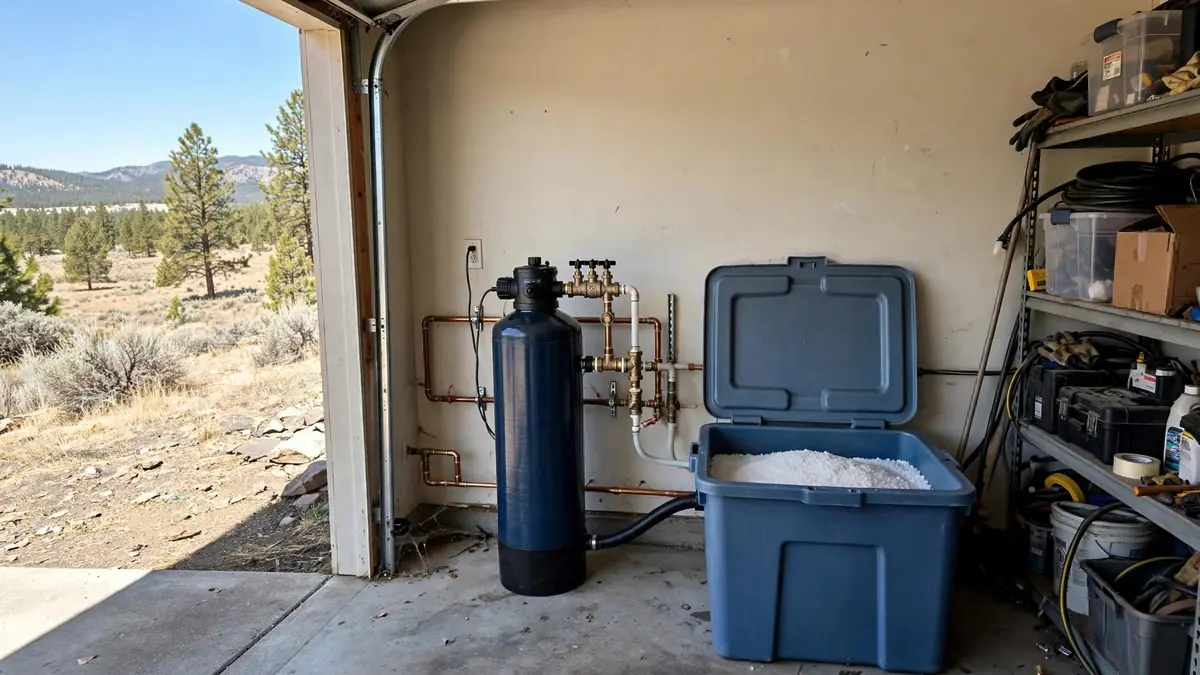
A salt-based softener swaps calcium and magnesium for sodium or potassium on a resin bed, then flushes the bed with brine. It is the type that actually removes hardness, and its performance is tested under NSF/ANSI Standard 44.
It needs a drain for the regeneration water, a place for salt and a power outlet. Sodium content in softened water matters to some households on restricted diets, and the plumber will point that out.
Salt-free conditioners
Salt-free systems change how scale forms rather than removing the minerals, and their results are debated. They need no salt or drain, which makes them easy to install.
Ask for independent test data on the claim before paying. A conditioner will not give the soft feel or the scale-free fixtures that a true softener does.
What a proper installation includes
The regeneration drain must be connected with an air gap or equivalent protection so wastewater cannot flow back into the supply. This is part of the Oregon Plumbing Specialty Code, built on the Uniform Plumbing Code (UPC), and it is a point inspectors check.
A bypass valve lets water flow while the unit is serviced. Hot water lines can be left unsoftened at a hose bib so outdoor taps get hard water, which avoids wasting softened water on a lawn.
Homes on septic systems should ask the installer about brine discharge and the system's capacity, since the regeneration water goes somewhere. A professional can help match the unit to the septic arrangement.
What moves the price of a softener job
Insurance does not cover softener installation. Keep manufacturer paperwork, since warranties on the control valve and tank often run longer than the labor.
Softener service across the region
Softener work is booked in Bend and in outlying homes on wells near Sisters. For a broader water concern, water filter installation explains test-first planning, and for scale inside an on-demand heater, tankless water heater service covers the flush.
City water inside Bend tests soft, so a softener is often unnecessary in Old Bend, NorthWest Crossing or River West. Homes on private wells outside the city are the ones where a hardness reading most often justifies a softener.
Water softener questions in Bend
The City of Bend reports soft to slightly hard water, about one to one and a half grains per gallon. Other sources and private wells can differ, so check your own reading.
On city water, usually not. On a private well with a high hardness reading, it may be worthwhile.
Ask your provider for its report, use a hardness test kit or send a sample to a lab. Lab tests are most reliable for wells.
Yes. Common repairs are salt bridges, a stuck control valve, a clogged injector and worn resin.
It can add regeneration water to the system. Ask the installer and a septic professional about capacity.
Only when you understand what they do. They reduce how scale forms but do not soften water like a salt-based unit.
Want a straight answer on softeners?
Call with your hardness reading for an honest recommendation.
Call (503) 974-3329