Backflow Testing & Prevention in Bend, OR
What Oregon requires, which assemblies need testing, and what happens if one fails.
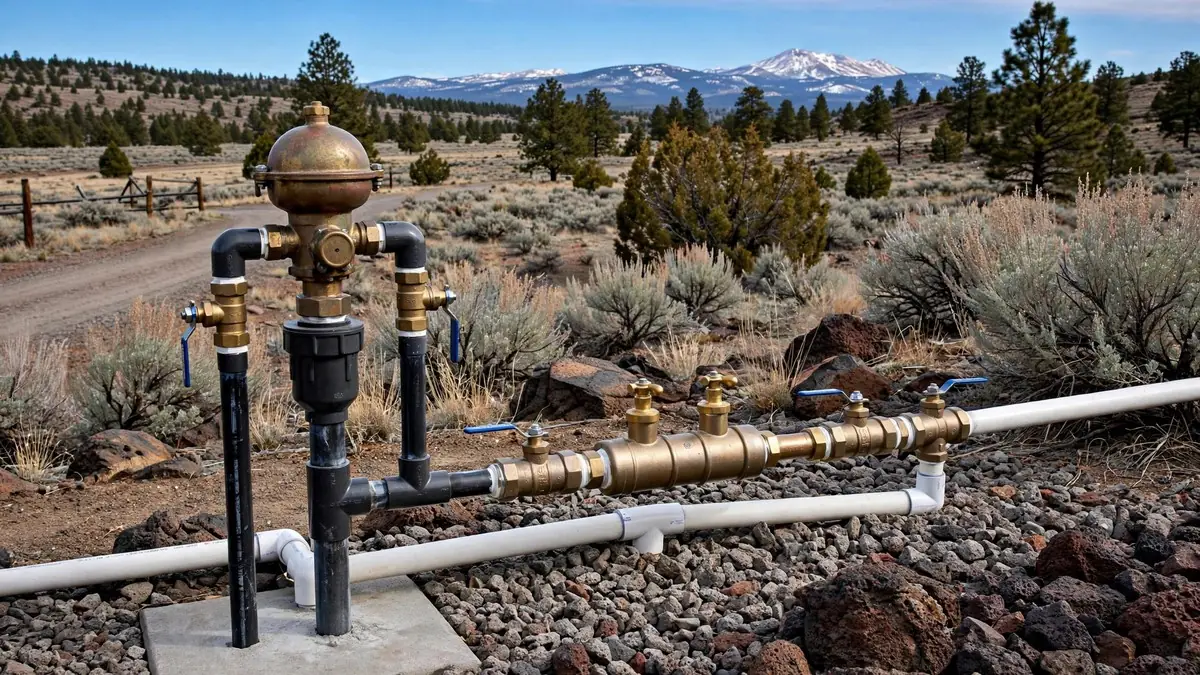
What a backflow preventer protects
A backflow preventer stops water from running the wrong way in a pipe. Without one, a pressure drop in the public main, such as a fire hydrant being opened, can pull water from an irrigation system, a boiler or a hose back into the drinking water supply. A one-way assembly in the line prevents that.
Backflow testing and prevention in Bend is about two jobs: installing the right assembly where a hazard exists, and getting it tested on the schedule Oregon requires. The second one is where most owners get caught, because the assembly is easy to forget until a notice arrives.
OAR 333-061 holds Oregon's cross-connection rules, and the water provider enforces them. They apply to residential and commercial properties, and the plumbing side falls under the Oregon Plumbing Specialty Code, built on the Uniform Plumbing Code (UPC).
Common situations and the assembly that fits
| Situation | Typical assembly | Notes |
|---|---|---|
| Underground irrigation system | Pressure vacuum breaker or double check assembly | Most common residential case |
| Property with a private well that also has utility water | Reduced pressure assembly | Prevents well water entering the utility side |
| Boiler or hydronic heating tied to the water supply | Reduced pressure assembly or approved device | Chemicals in the loop are the hazard |
| Commercial kitchen, car wash or lab | Reduced pressure assembly | Higher hazard, tighter rules |
| Fire suppression system | Double check detector assembly | Often handled by the fire contractor |
The table is general. Your water provider decides what assembly each hazard requires.
Testing, certification and deadlines
In Oregon, you must test a backflow assembly when it is installed, after any repair or move, and every year. A backflow assembly tester certified by the Oregon Health Authority must do the test with a calibrated test gauge. Reports go to the water provider.
Your water provider sets the reporting method and the deadline. In Bend that may be the city or another provider depending on your address, so ask which one applies and when the notice arrives. Missing the deadline can lead to fees or, in the worst cases, a shutoff.
Ask any tester for their current Oregon Health Authority certification number and look it up. A tester without it cannot file a valid report.
From shutoff to signed report
Locate and isolate
The plumber finds the assembly and closes the supply.
Connect the gauge
A calibrated test kit reads each check valve.
Record results
Pressures and serial number go on the report.
File and advise
The report is sent to the provider, with repairs noted.
Repair, rebuild or replace
Rebuild kits and parts
Many failed tests come from a fouled seat, a worn rubber part or a stuck check valve. A rebuild kit restores the assembly, and a retest follows. This is routine plumbing work and is usually quick.
Any repair triggers a new test. The old test result no longer counts once someone replaces parts.
Replacement
The plumber replaces an assembly that is corroded, frozen or no longer approved. Installation height, clearances and drain direction matter, and the Oregon Plumbing Specialty Code controls them. Test a new assembly at install and again each year.
Where the assembly sits in a freezing area, it needs winter protection. See the winterizing tips below.
Protecting an outdoor assembly in Central Oregon
Before you shut the system down for winter
- Shut off the water supply to the irrigation system and open the test cocks as the manufacturer directs.
- Blow out the sprinkler lines, or have them blown out, so no water remains in the pipes.
- Insulate the assembly with an approved cover if it sits above ground, and do not seal it airtight.
- Leave the ball valves in a half-open position if the manufacturer calls for it, to avoid cracking.
- Plan the annual test for the spring, before irrigation season, so repairs are done before demand peaks.
What affects backflow service pricing
Insurance does not cover testing or normal repairs. A failed or missing assembly can matter if a contamination event occurs, so keep your reports on file.
Who we test for
Service covers homes with irrigation or wells in Bend and nearby Redmond, plus businesses that fall under commercial plumbing. If your hose bibs lack vacuum breakers or you are replacing outdoor faucets, hose bib repair is the related page.
Irrigation systems in larger-lot neighborhoods such as Awbrey Butte, Tetherow and Century West need annual backflow assembly tests, and commercial properties in the Old Mill District have their own cross-connection rules. Ask about test report filing when you book.
Backflow testing questions in Bend
Every year, plus when it is installed, repaired or moved. Only an Oregon Health Authority-certified tester can do the test.
Yes, an underground irrigation system tied to the drinking water supply needs an approved assembly. Your water provider can confirm what type.
The tester usually files it with the water provider. Ask who does it before the visit.
The plumber repairs or rebuilds it and retests it. A failed assembly should not be left in service.
Yes. As long as the system is connected to your plumbing, the hazard and the requirement remain.
No. Oregon requires a certified tester with a calibrated gauge, and a self-test is not valid.