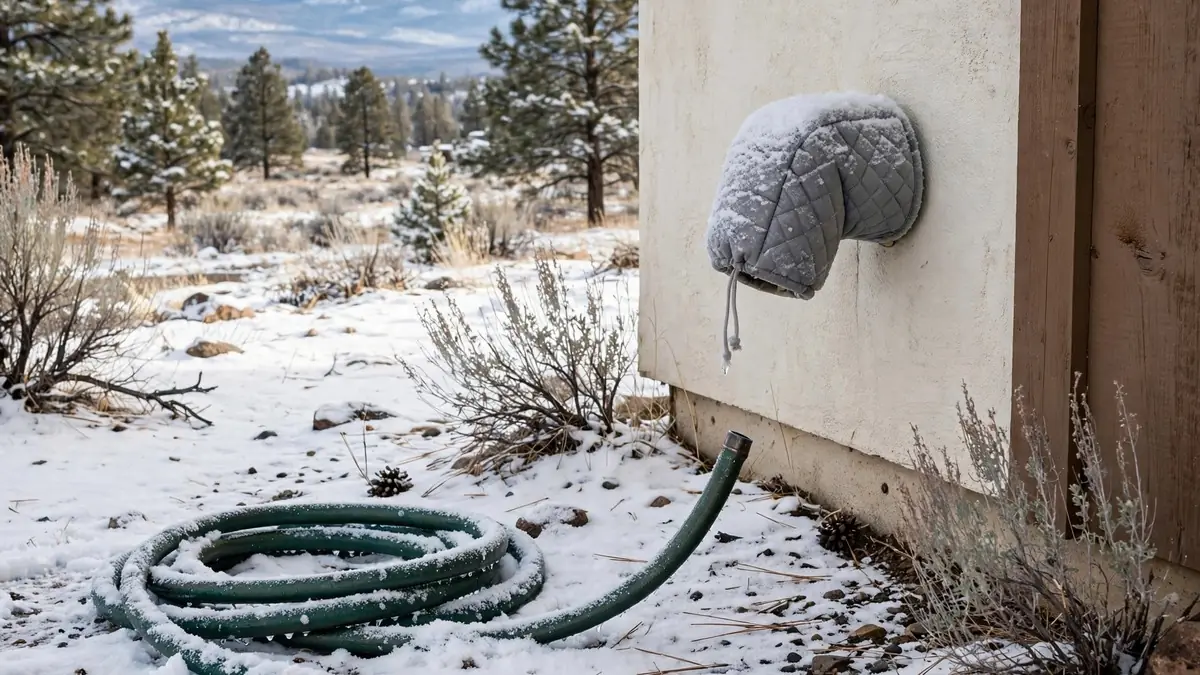
To winterize a hose bib, disconnect every hose, close any indoor shutoff, and drain the faucet. Even a frost-free spigot can split if a hose stays attached, since trapped water freezes in the barrel and cracks the pipe inside the wall.
The ten-minute fall job
Most outdoor faucet damage in Central Oregon happens in one cold night and gets discovered in spring. The cure is cheap and quick: disconnect every hose, drain the faucet, and cover it if it is exposed. Do it before the first hard freeze, not after the forecast turns.
A hose left connected is the number one cause of split pipes behind outdoor faucets. Water trapped in the hose and the faucet barrel freezes, expands and breaks the pipe inside the wall. The break stays hidden because the pipe is full of ice, and it leaks once the weather warms.
Is your faucet frost-free?
The City of Bend explains the test. Newer homes often have frost-free hose bibs, where the shutoff valve sits deep inside the insulated wall. If you turn the faucet off and water keeps draining from the spout for a few seconds, it is a good sign that it is frost-free.
Frost-free does not mean freeze-proof. The long barrel only works if it slopes slightly downward toward the outside so water can drain, and only if nothing is attached to the spout. A hose, a splitter or a timer holds water in the barrel and defeats the design.
Steps by faucet type
| Faucet type | How to tell | Winter step |
|---|---|---|
| Frost-free hose bib | Long barrel, water drains briefly after shutoff | Remove hose, check slope, cover if exposed |
| Standard hose bib | Short spout, no long barrel | Shut the indoor valve, open the outdoor spigot to drain |
| Bib with an indoor shutoff | Valve visible in basement or crawlspace | Close the valve, open outdoor tap, leave it open |
| Irrigation connection | Piped to sprinkler valves | Blow out the lines and drain the backflow device |
| Wall-mounted hydrant in a barn or shop | Often not frost-free | Drain and insulate or have a plumber check it |
Your fall checklist
Before you stash the hoses
- Disconnect every hose, splitter, timer and nozzle.
- Close any indoor shutoff to the outdoor faucet, then open the faucet to drain it.
- Look at the faucet and tilt your head: the spout should point slightly downward.
- Fit an insulated cover on faucets in exposed spots.
- Test each faucet after draining for a drip, a hiss or a damp patch inside.
- Make a list of any bib that dripped in summer, and have it fixed before winter.
Backflow devices and irrigation
Many outdoor faucets have a built-in vacuum breaker, a small cap on top that prevents water from flowing backward into the house supply. Plumbing code generally requires backflow protection on hose connections, and Oregon requires irrigation systems to have approved assemblies that are tested every year by a certified tester. Winterizing the system means draining that device too, as the backflow testing and prevention page explains.
If you have a sprinkler system, shut off the supply to it before you blow out the lines. Compressed air has to be used carefully, at the right pressure, or it can damage valves. Many homeowners hire a landscape company or a plumber for this each October.
Replacing an outdoor faucet: what to expect
A hose bib swap is quick as long as the pipe behind it is healthy. Expect the water to be shut off, the old faucet unscrewed, the threads cleaned and a new frost-free model with a built-in vacuum breaker installed. The new faucet is leveled to slope slightly downward, then tested under pressure.
If the pipe behind the old faucet has split, the plumber cuts out the damaged section and joins new pipe, which may require a small opening in the interior wall or the crawlspace. The quote should say who patches the wall.
Choose a faucet length that matches the wall thickness. A barrel that is too short does not put the valve inside the heated space, and the freeze protection is lost.
Barns, shops and vacation homes
Outbuildings and detached garages are where outdoor plumbing most often fails. Wall hydrants in barns and shops are often old non-frost-free types that rely on being drained by hand. Mark them, drain them and consider replacing with frost-free models.
For a second home, a plumber can drain all outdoor lines as part of a winter visit. An unattended house cannot be depended on to notice a dripping spigot, so the simplest safeguard is to close the interior shutoff to each outdoor faucet and leave the outdoor tap open.
Signs a bib is about to fail
Replace a bib that shows more than one of these signs. A new faucet costs far less than the wall it can ruin.
- A drip from the spout that continues after you close the faucet.
- A handle that is stiff or loose, or a stem that leaks around the packing.
- Rust, corrosion or mineral crust at the base.
- A faucet that is level or slopes toward the house.
- Dampness, staining or soft material on the interior wall behind it.
- A faucet that has frozen before, even if it did not leak at the time.
What to do when you find a leak in spring
Turn the faucet on slowly the first time in spring and watch the wall inside. A drip at the spout is a worn washer. Water inside the wall, a stain on drywall or a damp crawlspace points to a split pipe behind the faucet.
Close the indoor valve or the main if you see water. Replacing the bib may be enough, but a split often means a section of pipe also needs replacing, and the hose bib repair page describes how that is done. A split that has already soaked framing may overlap with hose bib and outdoor faucet repair and, in worse cases, split pipe repair.
In the Tumalo area, where many properties have long outdoor runs, barns and shops, wall-mounted hydrants are a frequent trouble spot.