Repiping & Whole-Home Pipe Replacement in Bend, OR
Replace worn supply piping throughout your house, with a survey first to see whether it is needed.
Signs the pipes inside your walls are wearing out
| What you see | What it may mean | Next step |
|---|---|---|
| Repeated pinhole leaks in different spots | Pipe wall thinning along its length | Camera or pressure survey, then a repipe quote |
| Rusty or brown water from several taps | Corroding galvanized steel | Test the water and inspect exposed pipe |
| Pressure falls as more taps open | Mineral or rust narrowing the pipe | Flow test at fixtures |
| Gray plastic pipe in the crawlspace or basement | Possible polybutylene supply pipe | Identify the material and plan replacement |
| Past freeze splits in several places | Weakened joints and fittings | Evaluate a staged repipe |
| Buying an older home | Unknown material and condition | Inspect during due diligence |
One leak does not mean a repipe. A pattern of leaks, or a material known for failure, is what changes the answer.
Repiping replaces the supply lines throughout the house
Repiping and whole-home pipe replacement means swapping the water supply pipes inside the building: the lines feeding sinks, showers, toilets, the water heater and appliances. It does not include the drain lines, and it does not include the buried line from the street, which is covered by water line repair.
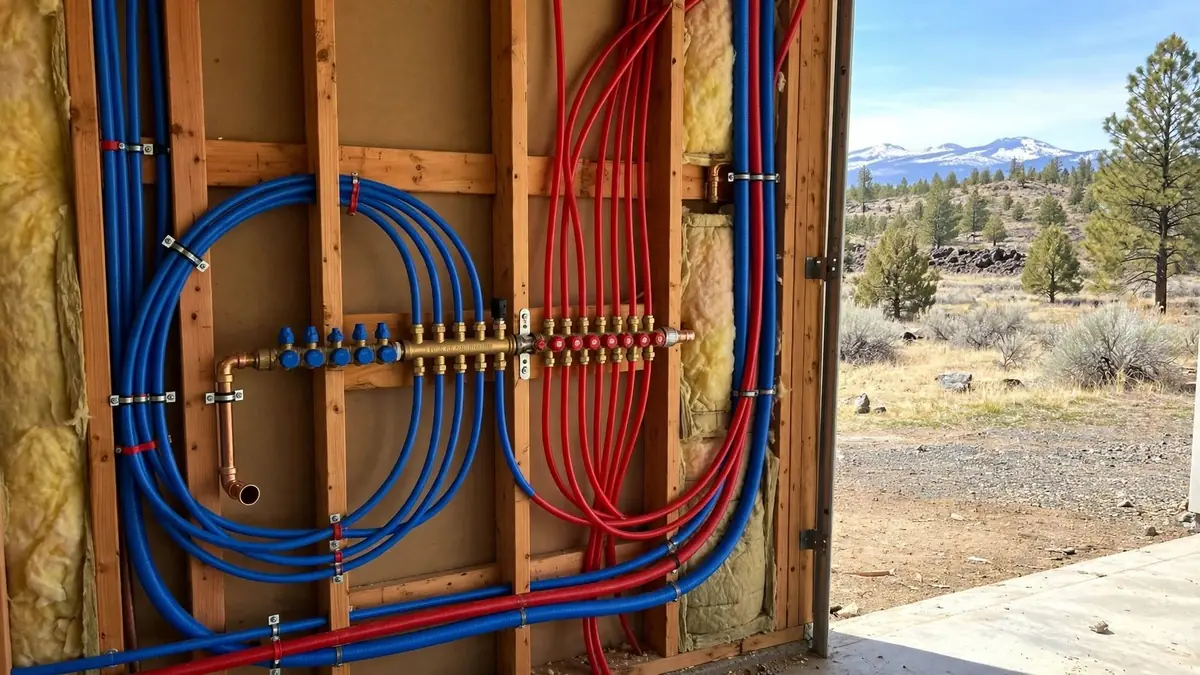
Builders used copper in most Bend homes and PEX in later ones. Older houses may have galvanized steel, and homes from roughly the late 1970s into the 1990s sometimes have gray polybutylene pipe, a plastic that was widely used and later associated with failures. A plumber can identify the material by sight and by markings on the pipe.
A repipe is a big job, so the first question is always whether you need one. A camera or pressure survey, plus a look at the pattern of leaks, usually answers that before any quote is written.
PEX, copper and what suits a cold-climate house
PEX
PEX is flexible plastic tubing that bends around corners, needs fewer fittings and goes in faster than copper. It tolerates freezing better than rigid pipe because it can expand slightly, though it can still split in a hard freeze, so insulation still matters.
It is the most common choice for repiping today. Ask for the NSF/ANSI Standard 61 and 14 marks, which show approval for drinking water use.
Copper
Copper lasts for decades, handles heat well and is a familiar choice for buyers and inspectors. It costs more in material and labor, and it is rigid, so it needs more fittings and more access.
Plumbers can install either material to the Oregon Plumbing Specialty Code, built on the Uniform Plumbing Code (UPC). Choice depends on budget, access, existing plumbing and personal preference.
The stages of a whole-home repipe
Survey and plan
The plumber maps fixtures and chooses routes.
Open access points
Small holes in walls and ceilings allow new lines.
Run and connect
Crews run new lines and tie them to the fixtures.
Test and patch
Pressure tests run before access holes are closed.
Most repipes happen in phases so the household can keep water on during the day. Ask how long water will be off each day and where the plumber plans to cut.
Questions that help you decide
Before you approve a full repipe
- Has the pipe failed in more than one place in the past few years?
- Is the material one that is known to degrade, such as galvanized steel or polybutylene?
- Does a camera or pressure test show widespread wall thinning?
- Would repairing the failed section cost a large share of a full repipe?
- Are you planning remodel work that already opens the walls?
- Does the quote name the pipe material, the fittings and the warranty?
What decides the cost of repiping
Insurance may cover water damage from a pipe that suddenly bursts but seldom pays for replacing aging pipe. Check your policy and ask about discounts that apply after a repipe.
Repiping across Bend and nearby
Repipe estimates are written for homes in Bend and in Redmond. If your main concern is a single leak, start with leak detection. If the issue is weak flow, low water pressure explains the checks that come first.
Repipe candidates are usually older homes in Old Bend, the Orchard District and near Pilot Butte, where original galvanized or early copper lines have corroded. Newer neighborhoods rarely need a full repipe unless a specific product has failed.
Repiping questions in Bend
Many houses take a few days, depending on size, access and material. The plumber should give a schedule and tell you when water will be off.
Usually yes. Water is off for part of each day, and the plumber works in phases to limit disruption.
It has a history of failures and is a common reason for repiping. A plumber can identify it and advise on replacement.
Crews cut small access holes where possible. The quote should state who patches and paints.
Oregon rules require a permit and an inspection for repiping. The licensed contractor should pull it.
Not usually. An active leak is, and a plumber can stop it before a full repipe is planned.
Wondering if your pipes need replacing?
Call to book a survey and a written quote.
Call (503) 974-3329