Slab Leak Detection & Repair in Bend, OR
Locate the leak under your concrete floor first, then choose a repair that fits.
Is your home on a slab?
A slab leak is a leak in a pipe that runs under or inside a concrete floor. Not every Bend home has that kind of foundation, and many are built over crawlspaces or basements. Slab plumbing shows up in garage floors, additions, some single-level homes and houses with in-floor heating tubes.
If your home sits on a crawlspace, pipes run where a plumber can see them, and leak tracing is the page for you. If part of the floor is concrete and a hot or cold supply runs through it, the information here applies.
Slab leak detection and repair in Bend begins by confirming the leak is under the concrete at all. Many suspected slab leaks turn out to be a line in an adjoining wall or a drain problem.
Signs of a leak beneath the floor
| Sign | What it suggests | How it is confirmed |
|---|---|---|
| Warm or hot spot on the floor | A hot water line leaking under it | Thermal imaging |
| Sound of water running, all fixtures off | Pressurized line leaking | Acoustic listening |
| Meter moves with house valve closed | Leak somewhere past the meter | Meter and pressure test |
| Damp carpet or cracking tile | Water coming up through the slab | Moisture reading and thermal imaging |
| Musty smell or visible mold at baseboards | Long-term moisture from below | Moisture mapping and leak location |
| Unexplained drop in hot water pressure | Hot line leaking under the floor | Isolate and test the hot line |
The warm floor spot is the clearest sign. Flooring that feels warm in summer with the heat off deserves a test.
How a slab leak is located without demolition
Isolate the system
Valves are closed to learn which line is leaking.
Listen and image
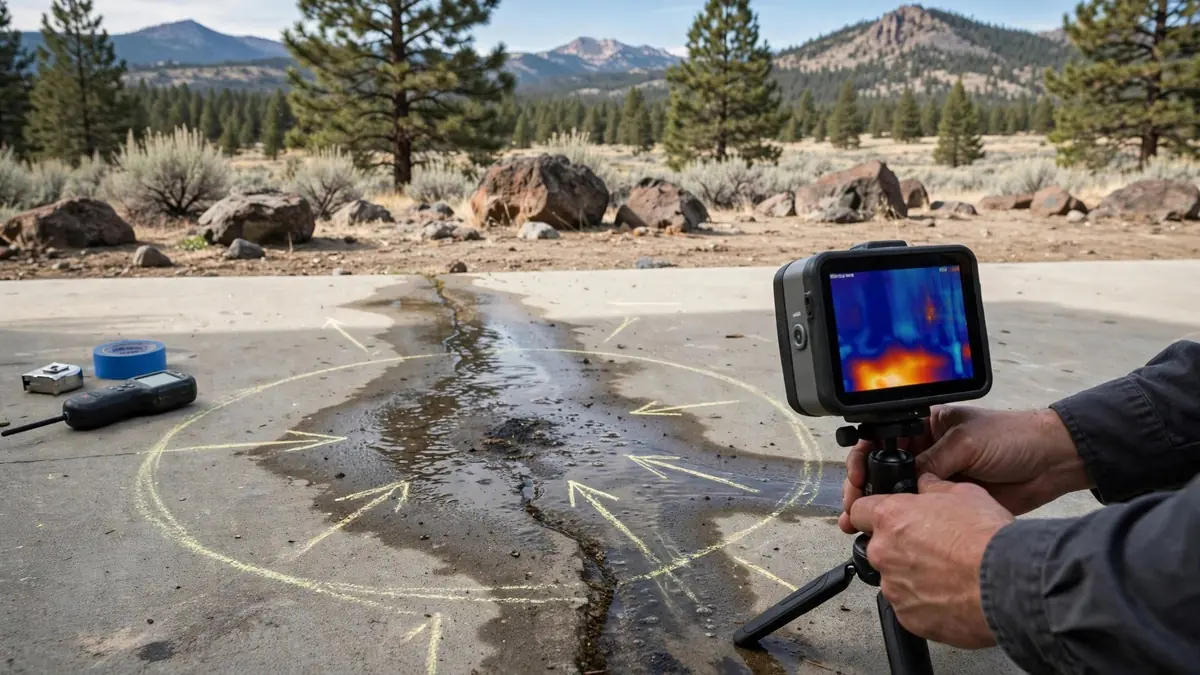
Acoustic gear and a thermal camera narrow the area.
Mark the spot
The location is marked on the floor to within a small area.
Choose the repair
Options and prices are explained before any cutting.
Break the slab, reroute or line the pipe
Spot repair through the slab
The plumber opens a small area of concrete directly over the leak, repairs the pipe to Uniform Plumbing Code (UPC) standards as adopted in Oregon, and patches the floor. It is the most direct fix and suits a single leak in an accessible spot. Flooring over the area is affected and needs repair.
A concrete saw and a patch are noisy and dusty. Plan for protection of nearby rooms and furniture.
Reroute or epoxy lining
Rerouting runs a new line through walls or the attic and abandons the old one under the slab. It avoids cutting concrete and gives a clear path for the future. It usually costs more up front on a short leak but can be better if the old line is failing in several places.
Epoxy lining coats the inside of the pipe to seal leaks and works where the pipe is structurally sound. It is not a fix for a heavily corroded or collapsed line, and a plumber should show why it fits.
What to do once you suspect a slab leak
Safety steps and damage control
- Close the main water valve if water is on the floor, or the house valve if the meter is moving but nothing is wet.
- If you suspect the hot line, close the cold supply valve to the water heater and turn off its power or gas.
- Keep out of standing water near outlets, appliances or cords, and turn off power to that area if you can reach the panel safely.
- Do not drill or cut into the slab yourself, since you could hit the pressurized line or an in-floor heating tube.
- Move rugs and furniture off damp flooring, photograph it, and note the date you first saw signs.
Why slab leaks get worse quietly
Water under a slab can erode the soil, raise moisture under flooring and feed mold. A small leak can run for months while the bill climbs and the floor degrades. A hot water leak under concrete adds energy cost too, since the heater keeps reheating water that leaks away.
Treat any confirmed slab leak as a repair to schedule soon, and an obvious flood as an emergency. If water is on the floor, close the main and call. Drying and mold work after the pipe is fixed falls under restoration after water damage.
What decides a slab leak quote
Many homeowners policies cover the cost of getting at a sudden leak, while slow leaks from wear are often excluded. Ask before the plumber starts and photograph the floor.
Slab leak service in Deschutes County
Slab leak calls come from Bend and nearby towns like Redmond. If the leak has already damaged drywall, the wall itself may need a look from a drying specialist, and the supply side can be reviewed with buried water line repair if the problem started before the house.
Many older Old Bend homes sit on crawlspaces, while some newer homes in Southern Crossing and Larkspur may have slab floors or slab additions. If your home has a slab, a warm floor spot or a moving meter points toward a line below it.
Slab leak questions in Bend
A warm floor spot, a moving meter with everything off, the sound of running water and damp flooring are the common signs. A plumber confirms with testing.
Sometimes. Rerouting through walls or the attic and lining the pipe can avoid cutting concrete. The right option depends on the pipe and the leak.
Active flooding is. A confirmed slow leak should be scheduled soon, since it keeps wetting the slab.
Often it covers access and resulting damage if the leak is sudden. Wear and slow leaks are commonly excluded.
Many homes use crawlspaces or basements, but slabs appear in garages, additions and some floors. Check your foundation before assuming.
Detection can take a few hours. Repair ranges from a day to a few days depending on method and flooring.
Think you have a leak under the floor?
Close the main if water is on the floor, then call.
Call (503) 974-3329