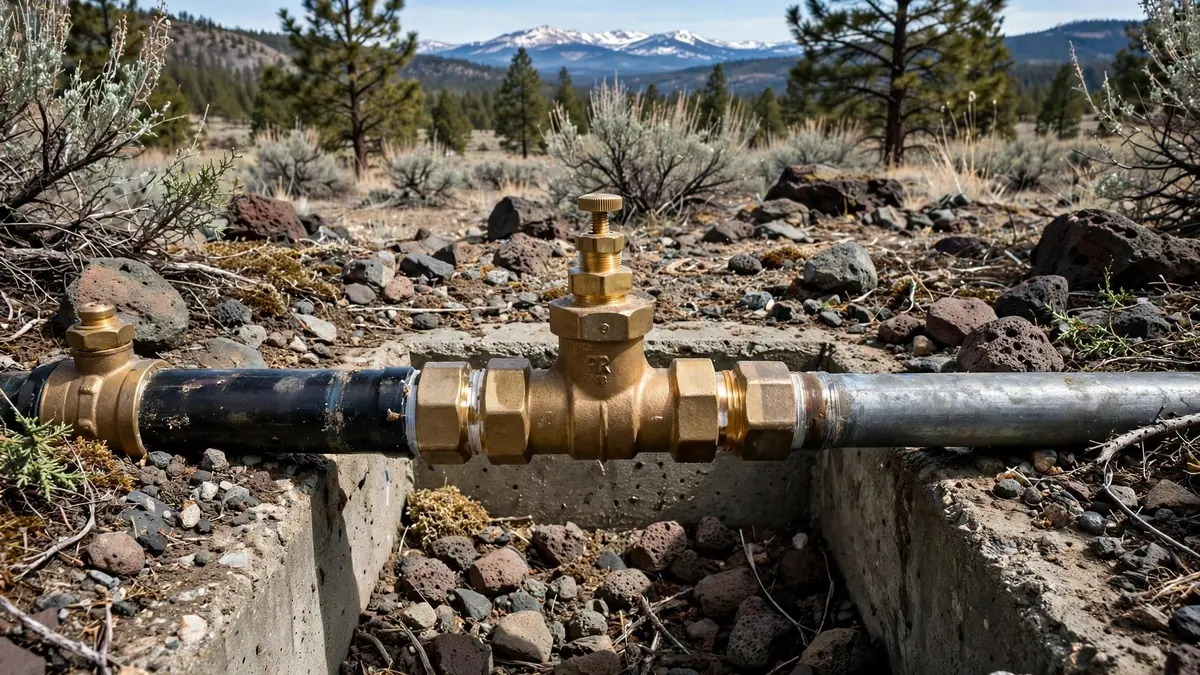
Check low water pressure with a cheap gauge on an outdoor hose bib. A cheap gauge on an outdoor spigot reports the incoming pressure, and where the weakness shows up, one tap, hot water only or the whole house, tells you whether to suspect the regulator, a valve, a pipe or a leak.
First, measure it
Low water pressure is a symptom with many causes, and guessing wastes money. The fastest way to narrow it down is a pressure gauge, a cheap tool that screws onto an outdoor hose bib. With no water running in the house, it shows the static pressure coming into your home.
Household pressure is typically happiest in the 40-to-60 psi range. Plumbing code, based on the Uniform Plumbing Code (UPC), requires a pressure-reducing valve when static pressure is above 80. If your gauge reads in the normal range but a fixture still feels weak, the problem is local. If the reading is low, it is systemic.
Read the pattern
The pattern is more useful than the symptom. A single weak tap and a weak house are rarely the same problem.
| Pattern | Likely cause | Next step |
|---|---|---|
| One faucet weak | Clogged aerator or a partly closed stop | Clean the aerator, open the stop fully |
| Hot weak, cold fine | Heater valves, tank sediment or a pitted hot line | Compare at one fixture, check heater valves |
| Whole house weak, gauge low | Regulator, partly closed main or supply leak | Check the main valve and regulator |
| Gauge normal but flow poor under load | Scaled or narrowed pipe | Flow test, then consider repiping |
| Pressure fell suddenly | Break in the line or a closed valve | Check the meter and valves |
| Wells: pressure swings | Switch, tank or pump | Read the gauge and listen to the pump |
The pressure regulator
Look near the main for a bell-shaped brass valve. That regulator steps street pressure down to something your fixtures can tolerate. A worn spring or seat lets pressure sag, bounce or climb. A regulator that has failed high is as bad as one that has failed low, since high pressure stresses fixtures, hoses and water heaters.
A plumber tests it by comparing the gauge before and after the valve. Swapping a regulator is quick when you can reach it, and for a house-wide complaint it is frequently the least expensive cure.
Valves, aerators and simple blockages
Quick checks anyone can do
- Confirm the main shutoff is fully open. A valve left partway after a repair is a classic cause.
- Unscrew the aerator on the weak faucet and rinse out the screen.
- Open the angle stops under the sink all the way.
- Check for a closed or partly closed valve near the water heater.
- Compare hot and cold at the same fixture to see which side is weak.
- Note whether the problem is worse at certain times of day.
Corroded pipe and hidden leaks
Galvanized steel plumbing slowly chokes itself with internal scale, leaving a narrow channel where a full-width pipe used to be. The static pressure at the gauge looks fine, but when several fixtures open, the flow collapses. That pattern points to pipe condition, and the fix is replacement of the narrowed section or a full repipe, covered on the repiping page.
A concealed leak on the run from the meter to the house can drag pressure down too, and your water bill usually gives it away. The meter test described on the leak detection page confirms it. If the leak is under a slab or in a buried line, the fix is different and costs more.
The hot side only
If cold pressure is strong and hot is weak, look at the water heater. Sediment at the bottom of a tank can restrict flow, the cold supply valve may be partly closed, and corroded fittings on the heater can narrow the opening. A tankless unit with scale on its heat exchanger throttles flow as well.
Check that both valves on the heater are fully open. If they are, flushing the tank or descaling the tankless unit often restores flow. If the problem remains, a plumber can test the hot line separately from the cold.
Remember that hot water pipes age faster than cold ones, since heat accelerates corrosion. A hot line that narrows over time is a reason to consider replacing that section.
Ranking the fixes by cost
Start at the top of the list. The cheap checks catch more problems than people expect.
| Fix | Typical effort | Likely payoff |
|---|---|---|
| Clean aerators and showerheads | Minutes, no tools | Solves a single weak tap |
| Open or replace a partly closed valve | Quick plumber visit | Restores whole-house flow |
| Replace the pressure regulator | A modest job | Fixes whole-house low or swinging pressure |
| Replace a section of corroded pipe | A larger job | Fixes flow loss under load |
| Repipe the house | A major job | Last resort for widespread pipe failure |
Pressure and your appliances
Pressure affects more than showers. A dishwasher and a washing machine need adequate pressure to fill, and a water heater, toilet fill valve and faucet can all misbehave when pressure swings. High pressure shortens appliance life, since hoses, seals and valves work harder under it.
If you replace a regulator, ask the plumber to set it for your household and to install an expansion tank if the water heater needs one. A closed system, where a regulator or check valve stops water from backing into the main, can spike pressure as the water heater heats, and an expansion tank absorbs that spike.
Hills, city supply and wells
City pressure depends partly on elevation. Elevation matters on a city system: houses on a rise see less pressure than those in a dip, and Bend has plenty of both. A pressure-reducing valve can bring pressure down but cannot create it. If a whole street has weak water, call the provider before you call a plumber, because the cause may be the city's or Avion's side of the meter.
On a private well, pressure comes from the tank and the switch, not from the street. A tank that has lost its air charge, a switch set too low or a worn pump gives weak flow, and the low water pressure page walks through the causes. In Sisters, where the city supplies water from wells and a reservoir, pressure follows the city system, while rural homes outside it rely on their own pumps.